
On the pearl, and what the oyster knew
The pearl has the power to free your mind, and when the mind is free, the soul follows.
The Sanskrit name for pearl is Muktā, which means freed, and it shares its root with mukti, liberation. The pearl is the Moon’s stone in the Navaratna, the nine gems of Vedic astrology, and the Moon governs the mind, the emotions, and the mother. What works on the Moon works on the mind, and what frees the mind assists in the freeing of the soul, which is the whole meaning of mukti and the purpose of this stone.
Muktā comes in many colours and from many sources, and the oyster pearl is only one of them. The oyster pearl belongs to the Moon. Other forms of muktā, such as ivory, belong to the fourth house, and the two are not interchangeable. Water belongs to this story as well, because the oyster pearl is born in it, and water’s nature is to heal, even where the illness is deadly. That is the power of Jala, the water element.
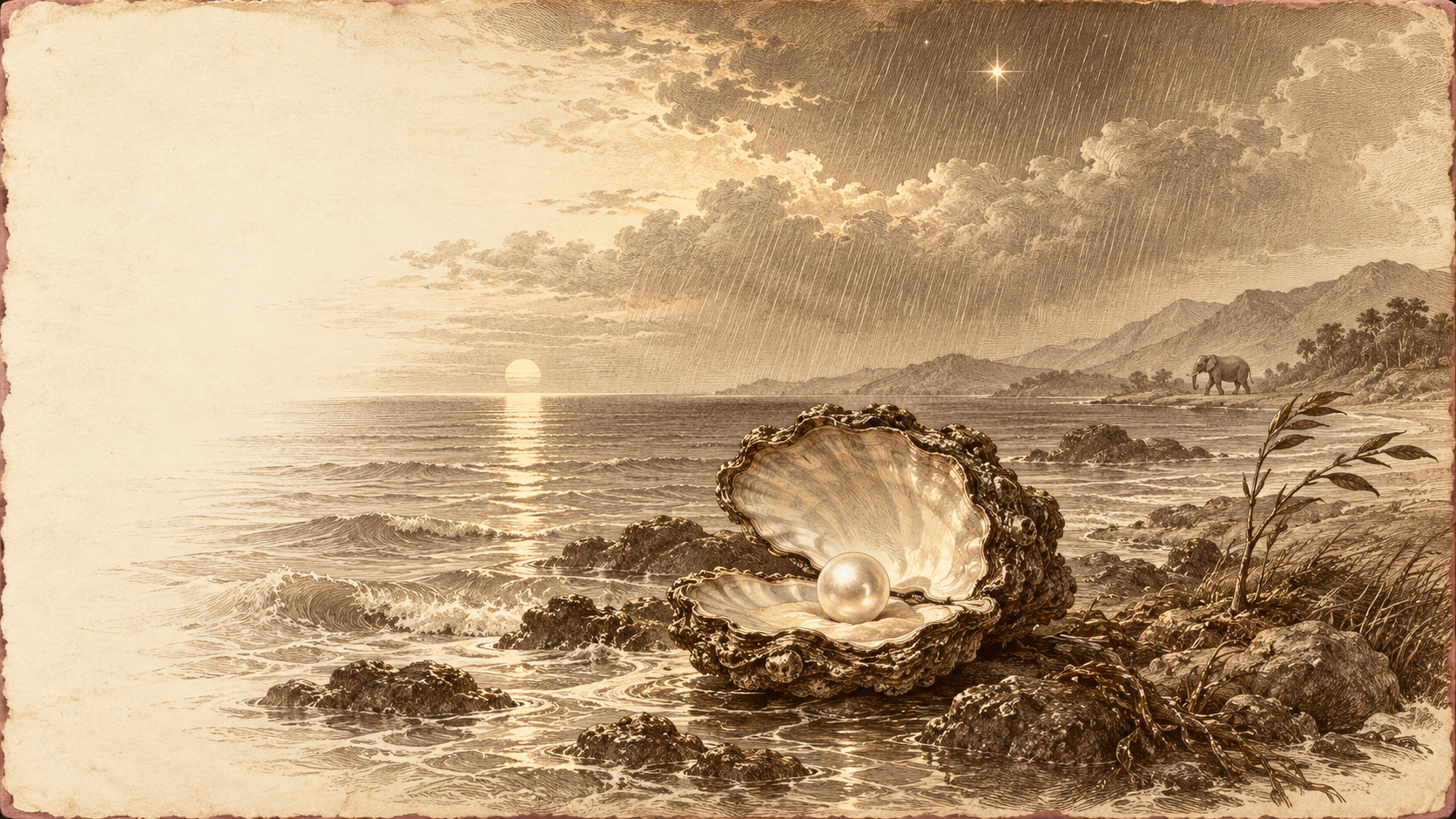
The Oyster’s Answer
The Moon is the fastest-moving of the nine planets, changing signs every two and a quarter days, always reflecting borrowed light. The Moon waxes, wanes, pulls the tides close and then lets them go, and the pearl carries that same quality: something luminous made from response rather than resistance.
And where does the pearl come from? The ocean. And who rules the ocean? Pisces. And Pisces is moksha, the final liberation, the sign that asks what you are willing to let go. So a stone named for freedom comes out of the very water that Pisces stands for, and the question worth carrying through this letter is who, in the making of it, was actually freed.
Sit with that for a moment. The oyster took in an irritant, something foreign, something uninvited, and over years of patient secretion turned it into nacre, layer upon layer, pressed into the walls of its own body. The pearl is what remained after the creature spent its life responding to something it could not expel. That is the Moon’s remedy: not a stone forged under pressure in the earth, but something built slowly by a living body that had no choice but to keep responding.
It is also the most delicate stone in the Navaratna, somewhere between 2.5 and 4.5 on the Mohs scale where a diamond is 10, and perfume, perspiration, and acid will dull its surface. That vulnerability is the point. The Moon’s stone is not meant to endure the way a diamond endures. The Moon’s stone is meant to respond, and a fine pearl will even reflect your image back to you like a small convex mirror, the stone of the mind showing you your own face.
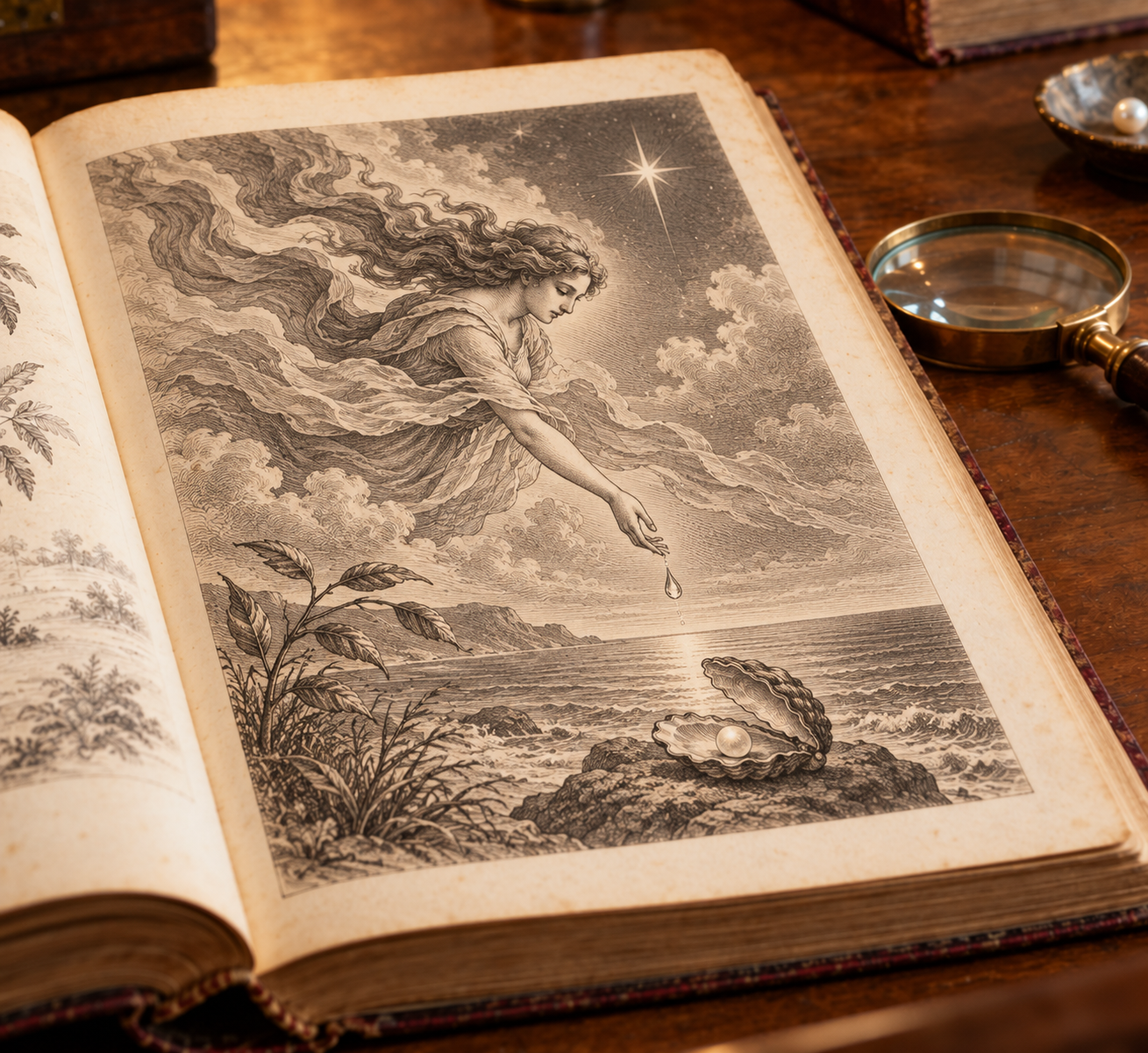
What Cannot Be Pierced
If you want a pearl to work as a remedy for longevity, it cannot have a hole in it. A pearl with a hole can still give other benefits, but long life is not one of them. The pearl must be set whole, it must touch the skin, and it must not be punctured. This is the Amala clause, and amala means pure, undefiled.
Here is how I understand it. The Moon, the significator, of the mind, and what you place on your body penetrates your consciousness at the level of vibration. The jīva, the life force, passes through the pearl, and an undrilled pearl holds that force intact, while a drilled one has been compromised, and that compromised vibration is what enters the mind of the wearer. It
is about what you are allowing into your own consciousness through a stone you chose to carry.
Gemology reaches a similar conclusion through a completely different door. Drilling stresses the nacre, and the layers around a hole can crack or peel over time, because layers built by a living body over years were never designed to accommodate a hole. What I read as a breach of wholeness, a gemologist would call a structural weakness.
Long life runs through the pearl in more than one way. A pearl worn in Svāti, a lunar mansion in Vedic astrology whose symbol is the pearl oyster, gives dīrghayu, long life, and Svāti is lorded by Rāhu, the north node that swallows the Moon’s light at an eclipse. The Moon’s own stone is given its long life under the star of the eclipse lord, as though borrowed light has to pass through its own shadow before it can last.
The Pearl That Is Not the Moon’s
There is a pearl that does not come from the sea at all. Muktā is wider than the oyster, and pearls come in many colours and from many sources: from ivory, from the bones of animals, even from skulls, human ones among them. Each carries its own force and its own possibilities.
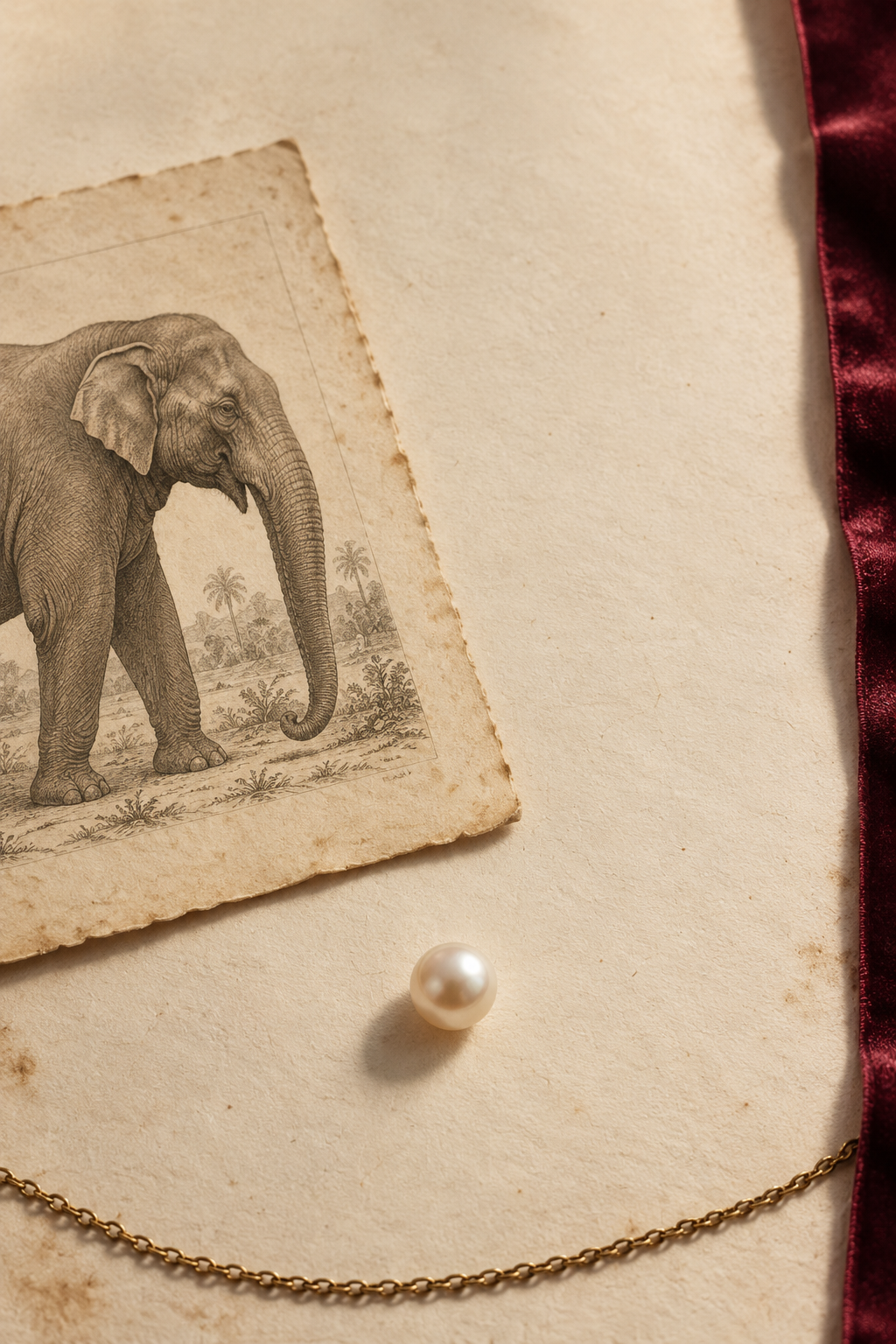
The Gaja Muktā, the elephant pearl, forms in the head of a bull elephant, and the elephant must be a male that died a natural death. If the elephant was killed, the karma of that killing enters the stone, and the pearl is said to not work. Elephant ivory has become illegal, which matters, but legality is not the deeper question. Something carried a jīva, and what counts is whether a life was taken for the stone, because that is the vibration you would be wearing against your skin.
The Gaja Muktā gives one hundred and twenty years of life. But here is what most people miss: the Gaja Muktā is not a Moon remedy. It belongs to the fourth house, the house of learning, and it is said to be the teeth of Ganesha. It can be worn by anyone and everyone, and it is very good for learning. One works on the mind through the Moon, the other on learning through the fourth house, and when we say pearl, we need to know which pearl we mean. Mammoth ivory is the alternative many people use, and it is accepted.
Not all pearls have the same effect, and the shapes, colours, uses, and purposes of the different pearls deserve a letter of their own, which I will be writing later in this series.
What Was Freed, What Was Taken
A natural pearl forms on its own. No one opened that shell and no one placed anything inside it. A cultured pearl exists because a technician implanted a bead, or a piece of tissue, into a living mollusc so the creature would coat it, and today the vast majority of pearls on the market are cultured.
Both are real pearls, and it takes a laboratory, usually with X-ray, to tell you which is which.
The pearl is named for freedom, but the creature that produced it was not free, and I would rather name that than pretend it does not exist. I hold a deep, practiced belief in ahimsā, non-harming, and I hold gemological training, and the pearl is where those two press against each other.
What impacts the mind impacts our karma, and what impacts our karma impacts our consciousness. We are wearing this stone for the Moon, the seat of the mind itself. Through the voyage of time, what has been lost? Are you receiving a gift, or inheriting a cost?
For those who choose the pearl and want to walk this with care, my counsel is to source something vintage, a pearl that has already been in the world, where the cost was already paid. Gemstones belong to Tamas, the heavy, material, binding force, while mantras and prayers belong to Sattva, the luminous force of purity. A gemstone strengthens you to carry your karma and does not remove it, and mantra and prayer work at a different level. Moonstone is a secondary gem for the Moon that does not require extraction from a living creature, and I will be writing more about sattvic alternatives in a future letter.
If the pearl calls to you, let it call clearly. Know what you are choosing and what was chosen before you arrived.
There is a moment, if you have ever held a natural pearl, when the surface warms against your skin faster than it would with most stones. It is organic. It was alive, or it was made by something alive, and that origin never fully leaves it.
The Moon’s light is borrowed. The pearl borrows its existence from a creature that had no say in the matter. And freedom, it turns out, is never uncomplicated. The most honest thing about the pearl is its name: what was freed, not what was taken.
Truly,
Krystal / Toronto
P.S. We stay in the water a little longer. The next stone belongs to Mars, and the red coral grows where the ocean floor meets something fiercer than the tide.