On the divisional charts of Vedic astrology, and a first look at the D60
Every family hands down more than photographs and recipes. Some things travel without ever being spoken, a way of loving, a way of fearing, a way of holding on, and for years I have wanted to understand how they reach us.
When I first began studying Vedic astrology, I took a course with Dr. Daniel Foor on ancestral lineage healing. Around that time I wanted to look at every birth chart I could, curious about what each one might hold beyond a single life: the patterns we inherit, the stories that keep moving through us, the threads that may have begun long before our first breath. That curiosity is what this letter is about, and in Vedic astrology it leads to the divisional charts and to the D60, the most refined chart I have learned and worked with so far.
It feels like the right season for it. As the light shortens, many of the stories around us turn toward the dead.
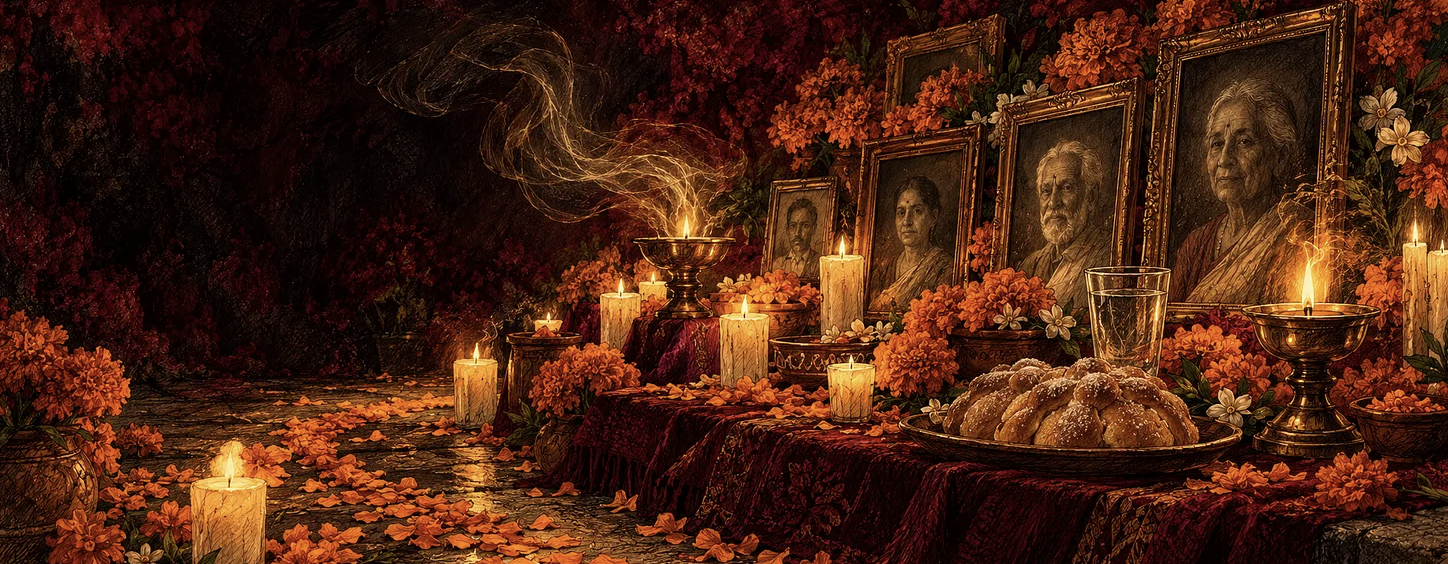
In Mexico, Día de Muertos, on November 1 and 2, is not a Mexican Halloween but an act of love and remembrance. The dead are believed to remain part of the community and to return for a short visit, welcomed at ofrendas, altars in homes and cemeteries, with photographs, candles, food, pan de muerto, and marigold petals scattered to guide them home. It weaves Indigenous traditions thousands of years old together with the Catholic days of All Saints and All Souls.
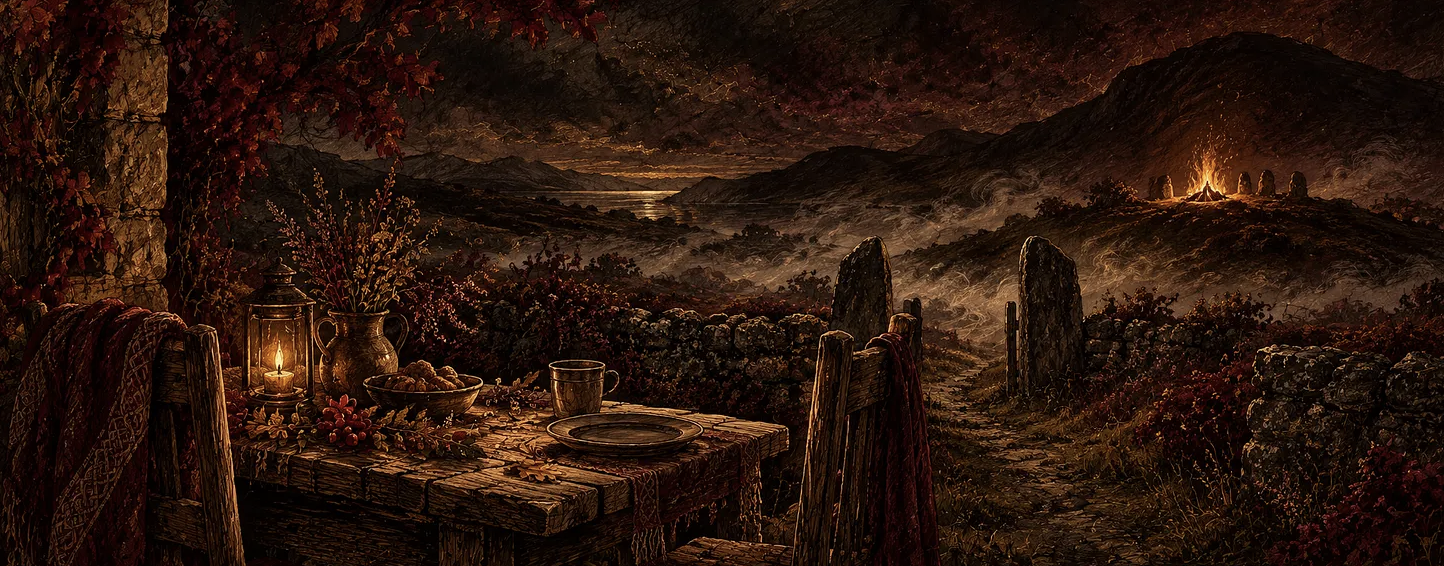
In Ireland, Samhain began at sunset on October 31, marking the end of the harvest and the start of the darker half of the Gaelic year. It was a threshold, a time when the boundary between this world and the Otherworld grew thin. Bonfires were lit for protection and cleansing, offerings were left for the spirits, and a place was set at the table for the dead coming home.
These traditions are distinct, and I do not want to make them say the same thing, but each remembers that the living and the dead have never stopped speaking to each other.
Astrology is not the only door I have knocked on. Family constellations, with the hidden loyalties they trace through a family, Bessel van der Kolk’s The Body Keeps the Score, with its picture of the body holding what the mind has no words for, and research on intergenerational trauma and epigenetics each ask, in their own language, what passes from one generation to the next. Each is its own lens with its own limits, and I hold them separately, but they all circle the same question.
A Chart Inside the Chart
In Vedic astrology, inheritance is approached through the varga system. A varga is a divisional chart. Each sign of the zodiac is divided into finer portions, and each way of dividing creates a new chart beside your birth chart, where the same planets stand in new places and ask a new question.
Picture the birth chart as a wide landscape seen from a hilltop. The vargas are the paths that lead down into one valley at a time. They are sometimes called avatars of the birth chart, which means expansions, a closer look at one dimension of the same life. They are not separate lives or separate destinies. They are the same life, looked into more deeply.
Each varga is a doorway into the same house. The D12, Dvādaśāṁśa, opens onto the parents, and onto the patterns we receive through them: the habits, fears, and strengths that feel like our own long before we learn where they came from. Beyond that doorway the family line seems to divide. The D40, Khavedāṁśa, is used to contemplate the maternal line, and the D45, Akṣavedāṁśa, the paternal line, so that the mother’s side and the father’s side each have a chart of their own to sit beside. Then there is the D30, Triṁśāṁśa, which turns toward difficult influences. It offers a way to look at what is painful or demanding, not as a verdict, but as something that may call for understanding and care.
The Spiral Up to the Soul
The number in each name tells how finely the sign has been divided. The larger the number, the closer the view. The vargas climb in a spiral through the elements. The charts nearest the birth chart, up to the D12, belong to earth, to the body and the household. Higher come water, fire, and air. Higher still, in ether, the element of space itself, sits the D60, Ṣaṣṭyāṁśa, the highest of the vargas I have learned and used.
This is the soul chart. It is not concerned with the body at all. It is tied to the Atman, the soul, the part of us that is understood to be divine, the part that knows right from wrong when the mind, the body, and our desires have lost their way.
Because every sign is divided into sixty portions, the D60 moves fast. Its rising sign can change within a few minutes, so a birth time that is off by even a little can show a different soul chart altogether. That is why the exact time of birth matters so much here, and why, when a birth time is uncertain, there are ways to rectify it, working back from the events of a life to find the moment that fits.
Between one life and the next, the D30 is understood to work as a filter, softening what the soul carries forward. That may be why most of us arrive without any memory of what came before. Yet sometimes a fear arrives with no beginning we can find in this life. In this framework, such fears are read as impressions that slipped through the filter.
The Soul’s Journey Here
The D60 has been called a powerful microscope for the soul. It is read for the karmas that will move through this life and for the decisions the soul made before it arrived, and when I look at it with ancestry in mind, it unfolds like a journey, one step after another, toward the moment of birth.
The journey begins with a pull. Birth is understood as the first sign of past karma, so the D60 asks what, or who, drew the soul back into a body. The answer is read from the planet in the D60 rising sign, alongside the eighth house, and each planet points toward a different kind of tie. The Moon may point toward a mother, the Sun toward a father, and Rahu, one of the two shadow points of the chart, toward the ancestors themselves. Even the strength of that planet tells part of the story. A planet in its weakest position is read as a humble prayer for birth, as though someone pleaded for this soul to come, and a planet in its strongest position as a promise or a vow being fulfilled.
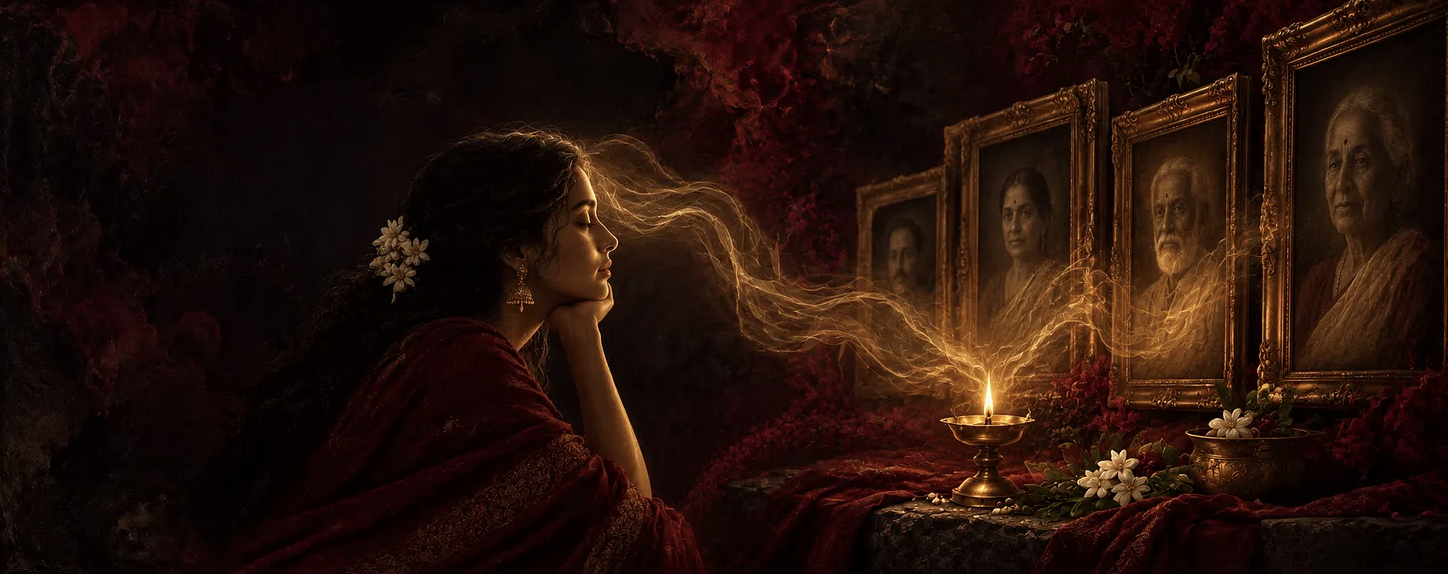
Then there are the ones who prayed. In the D60, the tenth house is the house of the sky, of space itself, and it is read as the record of the prayers offered before you arrived, as though each one rose into that open space and stayed there, waiting. The planet that rules this house shows the kind of prayer: Jupiter for a prayer to Shiva, Mercury for Vishnu, Venus for Durga, Saturn for fasting, and Ketu for severe penance. If your family does not come from these traditions, the names may still point to something familiar, the same archetypes your ancestors held in their hearts and prayed to in their own cultures, under their own names. Fasts and vows are remembered too, read from planets in Capricorn and Aquarius, so that Jupiter in Aquarius speaks of someone who fasted for Shiva, and Venus in Aquarius of someone who fasted for a spouse. Whose prayers I might be carrying. I do not read it as a claim about any one person’s history, only as a way of wondering whether a prayer, a fast, or a vow may have come before us, long before we knew to ask.
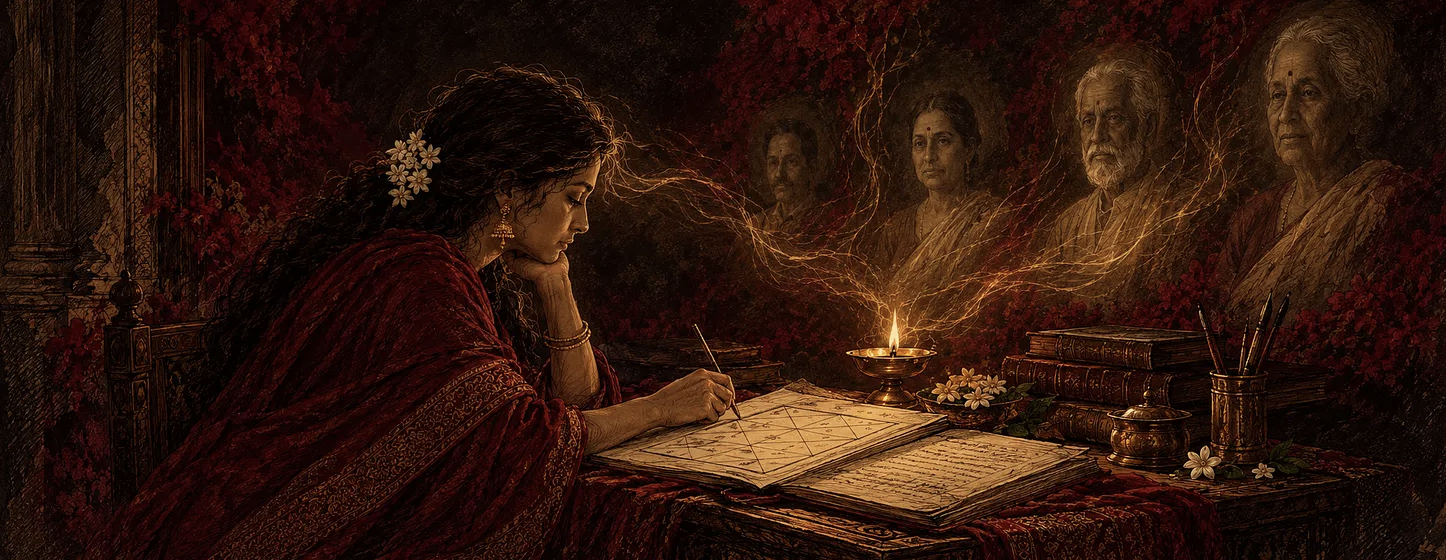
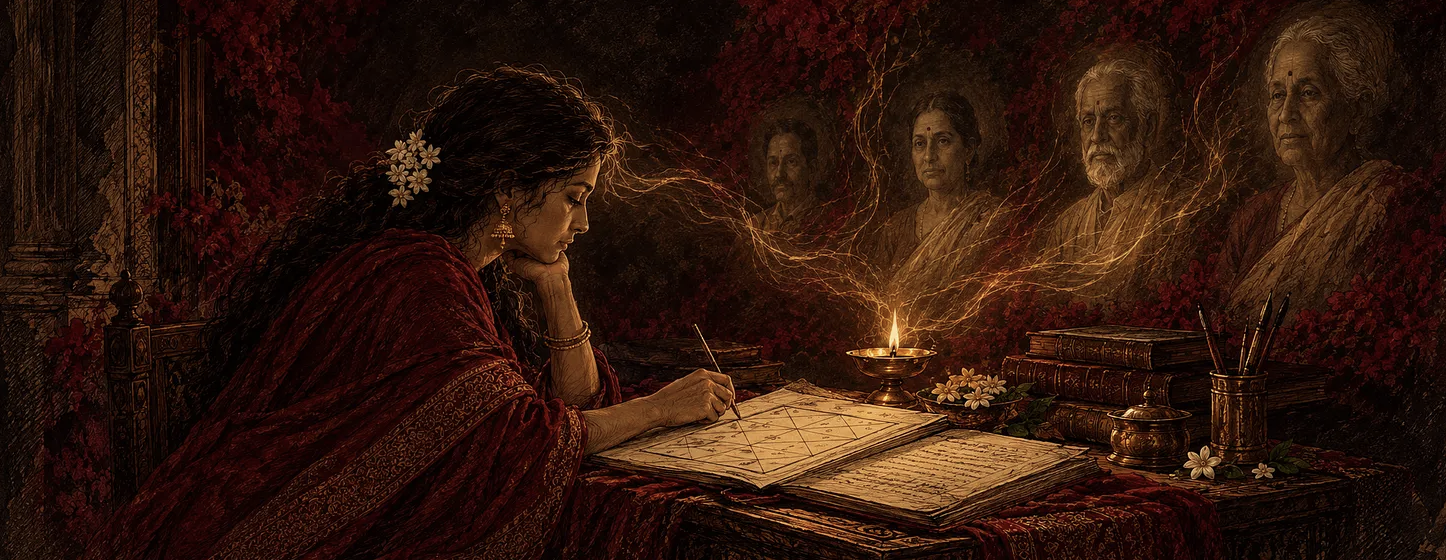
Before arriving, the soul makes one more visit. The twelfth house of the D60 is where your Rishi is found, one of the great sages, described as the mind-born sons of Saraswati, born of her thought rather than of a body, each one holding a particular kind of mind. The soul is said to travel to the realm of the Rishis as a baby, to gather the energy of its Rishi and carry it down to the earth, as though each of us went to the sage for the template of our mind before we came. And the sage does not leave us there, because it is your Rishi who repairs and restores the mind while you sleep. This is also where the ancestors enter, because Pitri Loka, the realm of the ancestors, is equated with the realm of the Rishis, and so the blood line is understood to trace back to the sages themselves, with some ancestral realms placed higher even than the realms of the gods. The ancestors, then, are not only in a family tree. They are present in the making of the mind itself.
And so the soul arrives, carrying the pull that drew it, the prayers that called it, the mind it was given, and a purpose. The lord of the D60 rising sign shows the main karma you came to fulfil, and the house where that planet sits shows whether the work leans toward dharma, the path of duty and the spirit, toward artha, the work of building and providing, or toward kama, the life of art, connection, and desire.
How I Hold This
I hold all of this with humility. A chart does not give me permission to turn mystery into certainty, and the D60 is a place where I would rather ask a question than announce an answer. There is far more in it than one letter can hold, including heavier material I have left out on purpose, because a window onto the soul should never be used to hand anyone a verdict.
What the vargas offer is a language for contemplation: a way to look at family, karma, and the less visible threads of a life, with greater attention.
I have never experienced the visible world as the whole of reality. The unseen has always felt close to human life, in the patterns we inherit, the rituals we keep, the people we remember, and the questions that keep following us home.
This season invites us to listen to those questions. Not to fold all the traditions into one, but to learn what each has carried in its own way, and to wonder what we, too, have inherited.
What do you feel you carry from the generations before you?
Truly,
Krystal / Toronto