
On the emerald, and what comes to those who follow well.
Marakata, That is the Sanskrit for emerald.
Markaṭa, That is the Sanskrit for monkey.
The emerald is Hanumān’s stone — the one who found his teacher and never once looked away.
His story is simple, he followed with devotion.
He was asked to cross an ocean, and he crossed it. He was asked to carry a message, and he carried it. He studied until there was nothing left to study. In the course of all that faithful, unglamorous following, every power a being can possess came to him. He hardly noticed, because he had not been looking for powers. He had been looking at his teacher.
That is the gift of this stone.

The Stone of Following
The emerald belongs to Mercury, called Saumya — the gentle one, the clever friend who sees no profit in a quarrel. Worn rightly, his stone makes you a student in the old and full sense of the word.
The emerald carries a second name as well: the stone of Garuda, king of birds, who has carried Vishnu — the preserver, the one who holds the world together between its making and its end — upon his back across the sky since before the world remembers, and whose wings, when he opens them, put the sun in shadow. It is another picture of the same virtue. The monkey follows; Garuda carries.
What Garuda’s stone does for the mind is very particular. A good emerald makes the thoughts clean. Unworthy ones need not be wrestled down; they simply find they have nowhere to sit.
It also guards one’s work. Mercury governs what a person does in the world, and the right emerald is said to keep those actions good. People come to this stone wanting money, and it may well oblige them. But what it properly offers is right action, which is rarer and lasts a good deal longer.
For more on the older language of gemstones, planets, and the lives they touch, subscribe to The Soultry.

For Those Who Perform
Mercury is the planet of mimicry. An emerald makes a person fluid and quick, able to step inside a character and wear it convincingly. This is connected with the power of to copy.
For an actor, that might appear in dance, dialogue, movement, or the quiet art of making us forget that we are watching someone perform. Actors have always been drawn to green without quite knowing why.
What You Are Actually Buying
This is where the romantic story meets the jeweller’s counter.
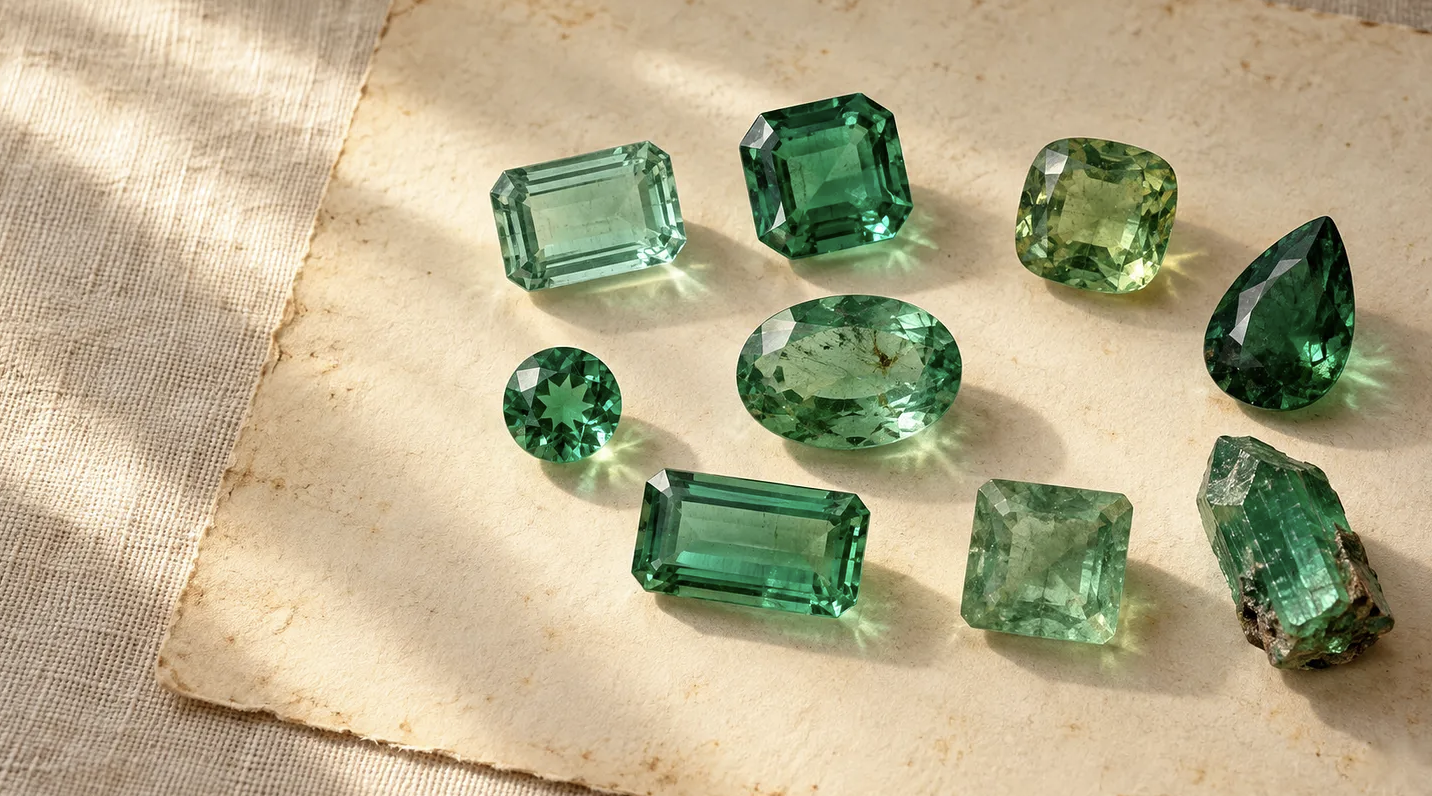
An emerald is not expected to be flawless. Most natural emeralds contain inclusions, sometimes called a jardin, and an eye-clean natural emerald is rare enough to command serious money. The thing to look for is not sterile perfection, but a stone whose colour is alive and whose internal life does not interrupt its beauty.
You should also know that many emeralds have been clarity enhanced. Their surface-reaching fractures may be filled with oil, wax, natural resin, or artificial resin in order to make them less visible. This is common practice. It is not, by itself, a reason to reject a stone. But it is a reason to ask better questions.
Ask what the filler is. Ask how much treatment there is. Ask whether the stone is natural, and whether it comes with an independent laboratory report. On a GIA report, the degree of clarity enhancement may be described as minor, moderate, or significant. Those words are worth understanding before you fall in love with a price, or a shade of green under jewellery-store lights.
A treatment that is minor may be perfectly reasonable. A stone with significant filling is a different proposition, and should be priced and cared for accordingly. Artificial resins, oils, and waxes do not all behave in the same way over time. Heat, chemicals, steam, and ultrasonic cleaning can affect them, or draw them out of the fractures they were placed to disguise.
So if you bring an emerald home, be gentle with it. Warm soapy water and a soft brush are sufficient. No steam. No ultrasonic cleaner. No heroic attempts to make it shine harder than it does.
The best emeralds ask for discernment. Which is, perhaps, very Mercurial of them.
Before You Put One On
But, a word of caution before you rush off to acquire one.
Mercury counters the influence of Rāhu. An emerald with serious flaws may therefore do the opposite of what one hopes, allowing Rāhu’s influence to grow stronger rather than steadier. This is why a remedial stone cannot be reduced to colour alone. Its quality matters, and so does the chart for which it is being chosen.
It also matters where the stone is worn. An emerald on the little finger may be useful for an occasion, even for a party, but it is not necessarily a stone to wear there permanently. The teaching is that it may withdraw a person from relationship and turn them towards celibacy or spiritual life.
Which is perfectly respectable, of course, if that is what you are seeking.
But it is rather a lot to discover after one innocent afternoon at the jeweller’s.
I return to Hanuman, the monkey, because he is the heart of it.
We live in a time that admires the self-taught and the self-made, and looks on devotion with a certain suspicion. The emerald belongs to an older idea, and I think a truer one: mastery is what happens while you are faithfully attending to something greater than yourself.
If you have ever had a teacher worth following, you know this already. If you have not, I can only say that the stone seems to help one turn up.
Truly,
Krystal / Toronto
If you enjoyed this letter, subscribe for more on the old astrology of gemstones, planets, and the strange ways they accompany a life.