
Into the Depths: Astrologer’s Gemstone Series
The Red Stone Before It Was Coral
On Pravala, the stone of Mars, and what may have been lost in its translation
Dear Reader,
In the last letter we spoke about the Moon and the pearl (What Was Freed), and this time we stay in the ocean realm, where one more stone is waiting.
Before I became a gemologist, I spent time on a small island in Indonesia where it poured and rained almost every day for ten days straight. Then came a day with some sunny breaks, and I went for a long walk along the shore, and there on the beach I began to pick up beautiful, bright red pieces of coral. By the end I had gathered at least a pound of it, without knowing its worth or its value. Where it ended up is a whole other story. What stays with me is the idea that it only came up after a storm had brewed.
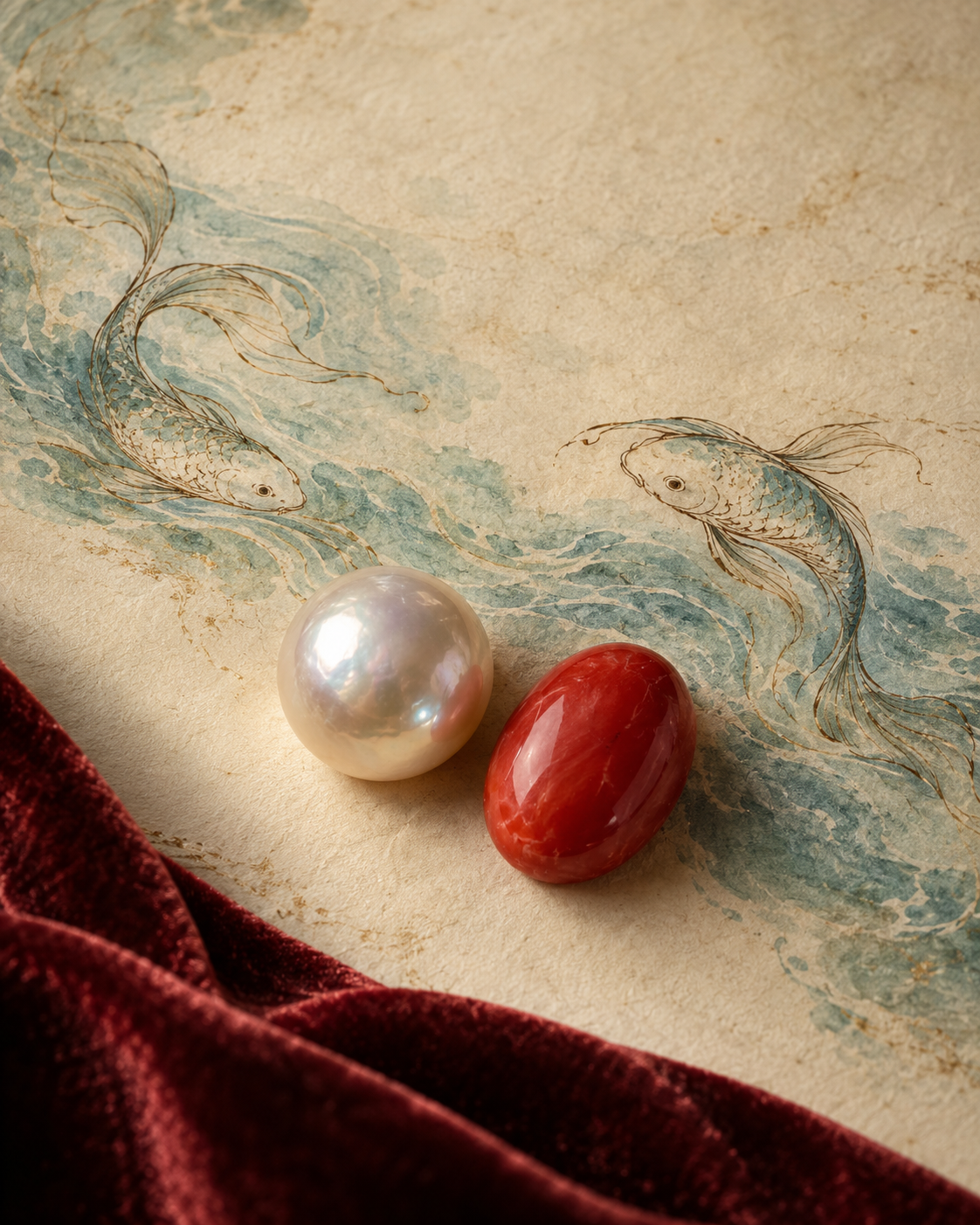
What I was gathering is the stone of Mars, and Mars belongs to the water just as the Moon does. The Moon is the mother who feeds you, and Mars is the mother who disciplines you, and I like to picture their stones as the two fishes of Pisces, one swimming up and the other swimming down. The one swimming up is the Moon. The one swimming down is the Maṅgala fish, which is Mars, and the energy of both is what we wear.
This letter follows one question about that red stone, which is what it was before it was called coral, and we will end back on that beach.
The Word That Got Lost on the Way to English
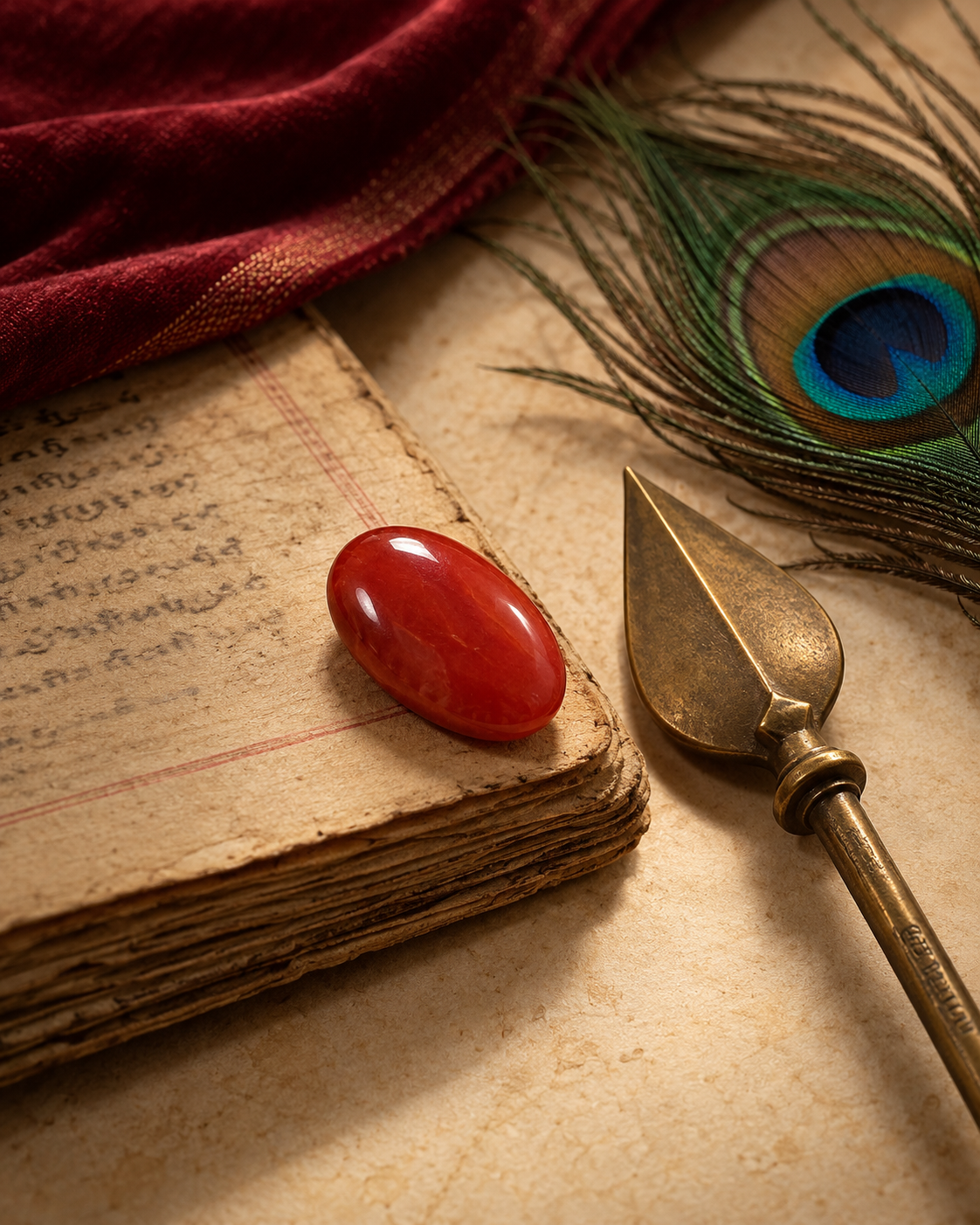
The stone of Mars has two names, and both point to the same stone. Vidruma is the Sanskrit name, and Pravala is the word most often used in India, so from here on I will call it Pravala. In English both have been translated as red coral, and that one English word hides more than it shows.
Here is the first thing it hides, and it is something that was taught to me rather than something I came to on my own. In the south of India, Pravala was a red seed that grew on trees, and garlands of those reddish seeds are still sold today in the temple town of Tirupati. That seed has the power to take heat away and cool things down.
Stay with that for a moment. A red seed that cools is a very different thing from a red stone pulled up from the sea, and yet one word has been asked to carry both. The red coral we know today comes out of the ocean, so somewhere between the tree and the sea something was translated, and since hearing this I have come to wonder how much may have been lost in that translation, and how much we no longer know.
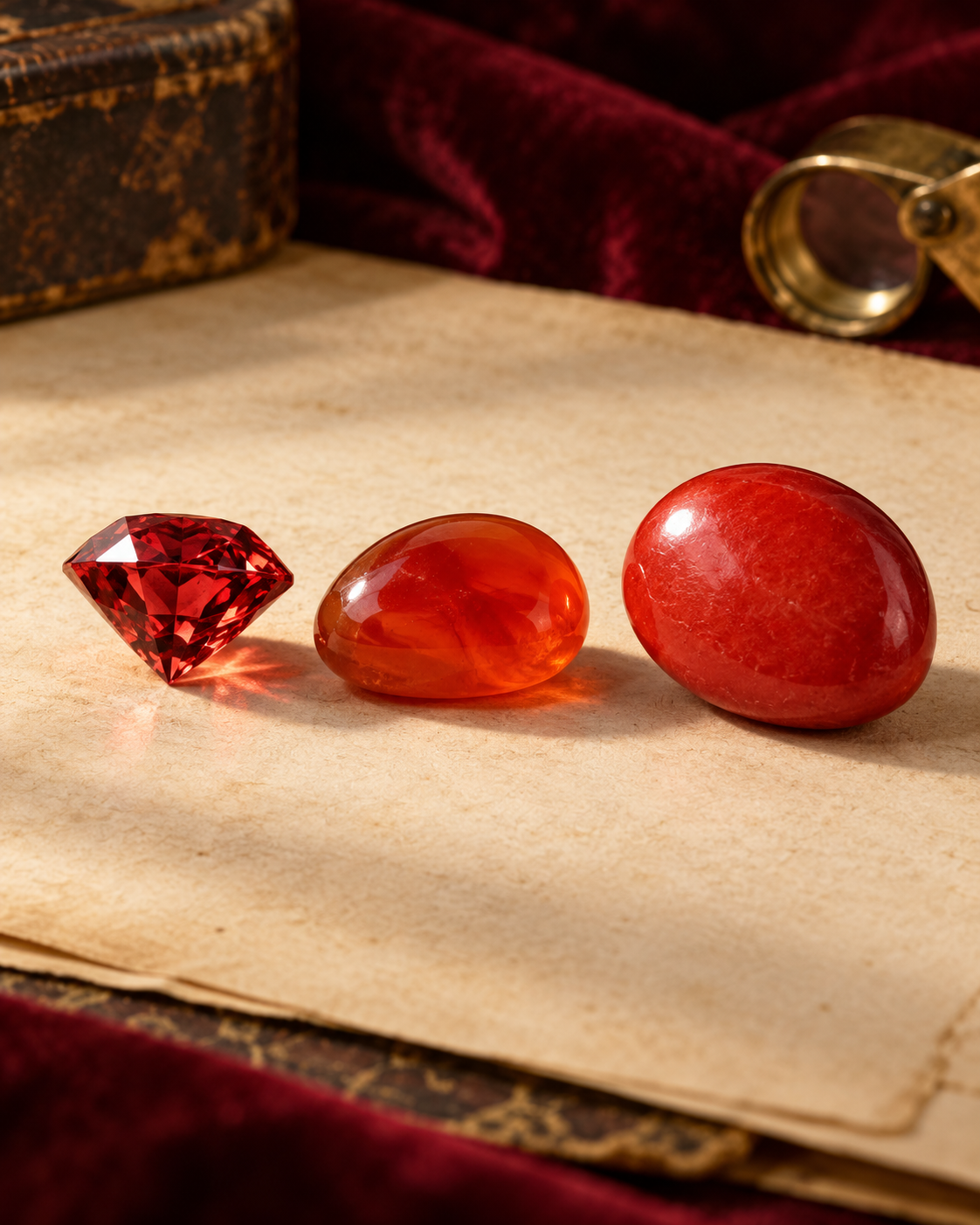
This is why I do not treat red coral alone as the answer to Mars. There are other beautiful red stones, the carnelian among them, which is also cooling and takes the heat off.
The Bangle on the Right Arm
The word holds one more clue, and it is about size. Pravala means the large pieces of the stone, not small beads, and a large piece was never really meant to sit on a finger.
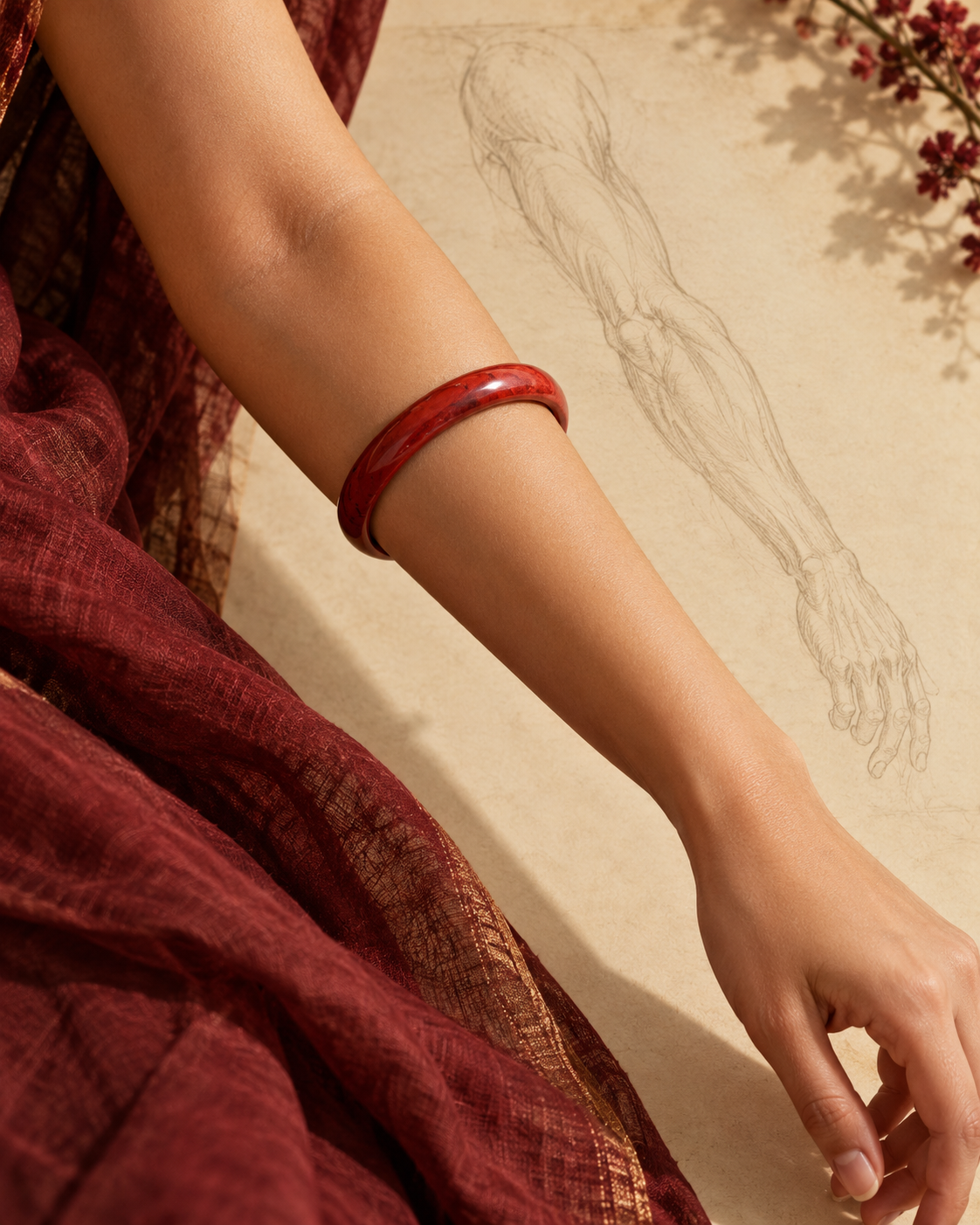
Traditionally, Pravala was worn as a bangle on the right forearm, or as an amulet at the neck or over the heart, held close to the body rather than placed on the hand.
And this is where the red stone stops being only a gem and becomes a blessing. A woman who wears the red bangle of Pravala on her right hand is called Mangala, and the blessing that goes with it is said to be that her husband will not die before her and that she will not see sorrow, loneliness, or suffering. In Bengal it was once widely worn, and in Nepal red coral is worn for the mangalya, the marriage vow, so that a wife will not become a widow. Any woman can wear it.
Red bangles have long been part of how Indian women dress, though today they are mostly made from lac, a natural resin. The bangle made from Pravala itself is the one meant for this blessing, and it is very expensive. Even a large piece of Pravala set into a lac bangle can still work, because it acts as an amulet.
The ring on the right hand came later, more as a fashion, and it carries a gentler use. Pravala is also worn for the nerves, by people with nervous energy and anxiety, who can be calmed by wearing it over the heart during meditation or on the ring finger of the right hand. In that role it works as a medical stone, meant to calm the nerves.
And this is where the red stone stops being only a gem and becomes a blessing. A woman who wears the red bangle of Pravala on her right hand is called Mangala, and the blessing that goes with it is said to be that her husband will not die before her and that she will not see sorrow, loneliness, or suffering. In Bengal it was once widely worn, and in Nepal red coral is worn for the mangalya, the marriage vow, so that a wife will not become a widow. Any woman can wear it.
Red bangles have long been part of how Indian women dress, though today they are mostly made from lac, a natural resin. The bangle made from Pravala itself is the one meant for this blessing, and it is very expensive. Even a large piece of Pravala set into a lac bangle can still work, because it acts as an amulet.
The ring on the right hand came later, more as a fashion, and it carries a gentler use. Pravala is also worn for the nerves, by people with nervous energy and anxiety, who can be calmed by wearing it over the heart during meditation or on the ring finger of the right hand. In that role it works as a medical stone, meant to calm the nerves.
Two Colours of Fire, and Who Should Be Careful
So far we have talked about where the stone sits and what it blesses, but a stone this red also asks something of the one who wears it. Red coral is an opaque stone, a tamas stone, carrying the dense, earthy quality that belongs to the body, and that is why it strengthens the body. Most people stop at the strength, and Mars does not.
Hanuman is one of the faces of Mars, and his enormous strength is matched by his devotion. Set beside him the demon king Rāvaṇa, who had great strength too but no purity, and you can see what Mars is really asking for. Strength must come with purity, and it is a mistake to pray for strength without it, because strength on its own leads to bad things. This is the discipline of the mother who disciplines.
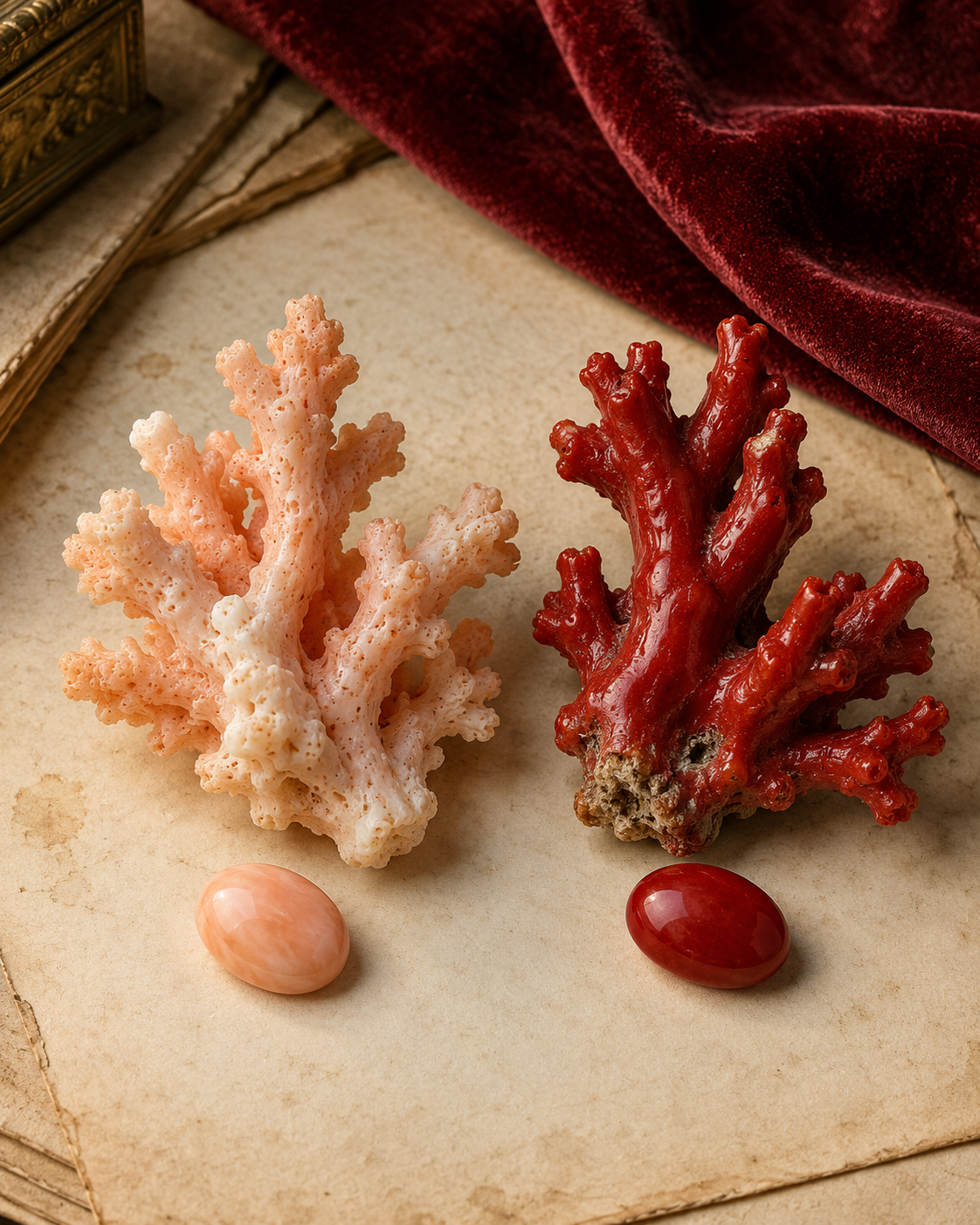
That is why the fire of this stone has to be read by its colour before anything else, and the best place to begin is on the shore near Somnath, the temple on the coast of Gujarat, where a pale Pravala is found. It is a very light orange, almost whitish, with the two colours showing in it, and it is the Pravala for calming Mars. Some horoscopes carry a Mars that is very angry and agitated, a fighting Mars, and this is the stone that settles him. The orange in the stone belongs more to the Moon than to Mars, a more lunar colour, the energy of the mother of Mars, and so the gentlest face of the coral turns out to be a mother’s.
From there the stone changes character completely as the red deepens. The dark red is pure Agni, fire, and Agni asks for strict obedience to all the rules of dharma. A very dark coral worn in large quantity can raise a great deal of Agni inside you, which is why the rest of the chart and the body need to be looked at before you put it on, to see whether you can take that heat.
And that brings us to who should be careful, which begins with temperature. Mars is pure fire, the hot extreme among the planets, and Saturn is the cold one, with Venus running hot on Mars’s side. In other words, some charts already run hot before a single stone is added. When a chart already carries a very powerful Mars, more heat cannot be prescribed to the body, because the person could go out of control, and so Aries rising and Leo rising, which are hot already, should avoid wearing too much red Pravala.
The Moon changes the picture too. Where the Moon sits with Mars, the person’s hand is hot to the touch, the blood already carries too much heat, and red coral on top of that can bring eruptions in the body. For that combination no hot gemstone belongs on the hand, and mantras are what calm Mars down.
The same stone can be a mother’s comfort or a furnace, and the colour, the chart, and the body decide which.
What the Chart Gets to Say
None of this means everyone should put on a coral. This series began with the idea that a gemstone is prescribed for the mind first, and that it is read from the chart and not from its reputation (Why Gemstones Start with Your Brain, Not Your Birth Chart). The stone of Mars follows the same rule as every other stone, and the chart can say yes, no, or something else altogether.
Start with a chart where Mars is the trouble. In a Pisces rising chart, Mars lords the ninth house, the house of fortune, and too much of him ruins that fortune, with every beginning destroyed by one battle after another. There is a simple formula for a troubled ninth house, which is to seek the planet that answers the troublemaker, and when the troublemaker is Mars, the answer is the Moon. So we come back to the two mothers, and the remedy for that Mars is the pearl, the other gem of the ocean, whose story you can read in What Was Freed.
The pearl can also be placed with intention. The little finger belongs to relationships, and a pearl there calms a Mars sitting in the seventh house, so that the agitation and anger that ruin a marriage do not take hold. Most of us carry some latent anger around the seventh house, the house of the spouse, and a pearl on the little finger helps to overcome it. A pearl will end fighting.
Where the Stone Comes From
Coral is difficult to get now, and it is not environmentally right. Soft coral exists, and a handful of small soft-coral pieces can be made into a Mangal yantra, a sacred diagram for Mars, but if you are going to use a gemstone you have to use it properly, or it is only mental satisfaction.
As a gemologist, I can add what the loupe adds. Coral is the calcified skeleton of tiny marine polyps, which makes it an organic gem, and the natural pink to red colour comes from a carotene pigment. It is soft, about 3 to 4 on the Mohs scale that gemologists use for hardness, and porous, so perfume, chlorine, and heat can dull it. Dyeing, bleaching, wax impregnation, and plastic stabilization are all common treatments, and a seller should disclose every one of them. Coral is also imitated, in glass, plastic, and dyed limestone, and there is a reconstructed coral made of coral powder bound and dyed. So when you shop, ask whether the colour is natural and ask for it in writing. A stone meant to steady you should at least be what it claims to be.
Back on the Beach
So what was the red stone before it was coral? It was a seed that cools, a bangle on a woman’s right forearm, a pale orange mother, and a fire that asks for rules.
I will never forget that long walk along the shore. I was in my Jupiter-Mars dasha at the time, a period of my life ruled by Jupiter and Mars, and I sometimes wonder whether finding that coral was a remedy in itself, a part of what I needed then. The coral only came up after a storm had brewed.
If the red calls to you, let it call clearly, and know what you are really asking the stone to do.
Truly,
Krystal / Toronto
P.S. Our next stop is Rahu, and his stone, the hessonite, which is called Gomedha in Sanskrit and is the stone of the eclipse. Subscribe to keep exploring astrological gemstones with me.