
Why gemstones start with your brain, not your birth chart
Into the Depths: A Gemstone Series (Ratna) — Part One of Nine
(Ratna — the Sanskrit word for gemstone)
For the seeker, the feeler, and the discerning buyer
By Krystal Soultry of The Soultry — Vedic astrologer and gemologist
About This Series
You have felt the pull of a stone. You have held one in a shop and not wanted to put it down. You have wondered, not entirely rationally, whether the right piece of jewelry might change something.
You are not wrong to wonder.
Into the Depths: A Gemstone Series (Ratna) is a nine-part introductory series drawing on the Navaratna Jyotiṣa teachings of Pandit Sanjay Rath — one of the most respected living masters of Vedic astrology — translated here for the modern seeker who also intends to buy. Not to collect. Not to accessorize. To remedy.
I come to this work as both a Vedic astrologer and a trained gemologist. The two lenses are inseparable. A gemologist without the astrological framework is selling you jewelry. A Vedic astrologer without the gemological eye is sending you into a market unarmed. You deserve both. This series is both.
Read in order, or find the post that answers the question you already have. Either way, by the end, you will know what you are buying — and why.
Dear Reader,
I, too, arrived with a list.
Before I sat in Guruji’s classroom — before I became the kind of student who takes notes in Sanskrit and argues about navamsas at eleven in the morning — I was exactly the person I am about to describe to you. Curious. Enthusiastic. Carrying a small, confident shortlist of stones I had decided were mine.
I was not entirely wrong about the stones. I was wrong about why.
The Lagna Is Not Where You Think It Is
There is a question I receive at least once a week, in some variation, from people who have just discovered Vedic astrology and arrived at the gemstone chapter with considerable enthusiasm and very little patience.
Which stone is mine?
They mean: which stone belongs to their Sun sign? Their Moon sign? The planet that keeps appearing in conversations about their chart? They have read things. They have a list. They are, frankly, ready to purchase.
I understand this completely. And I am going to ask you, with all the warmth I have, to set the list down for a moment.
Because Pandit Sanjay Rath — Guruji, as his students know him — opens the entire subject of planetary gemstones not with the stones themselves, but with a single, quiet, rather startling statement:
Lagna is your brain.
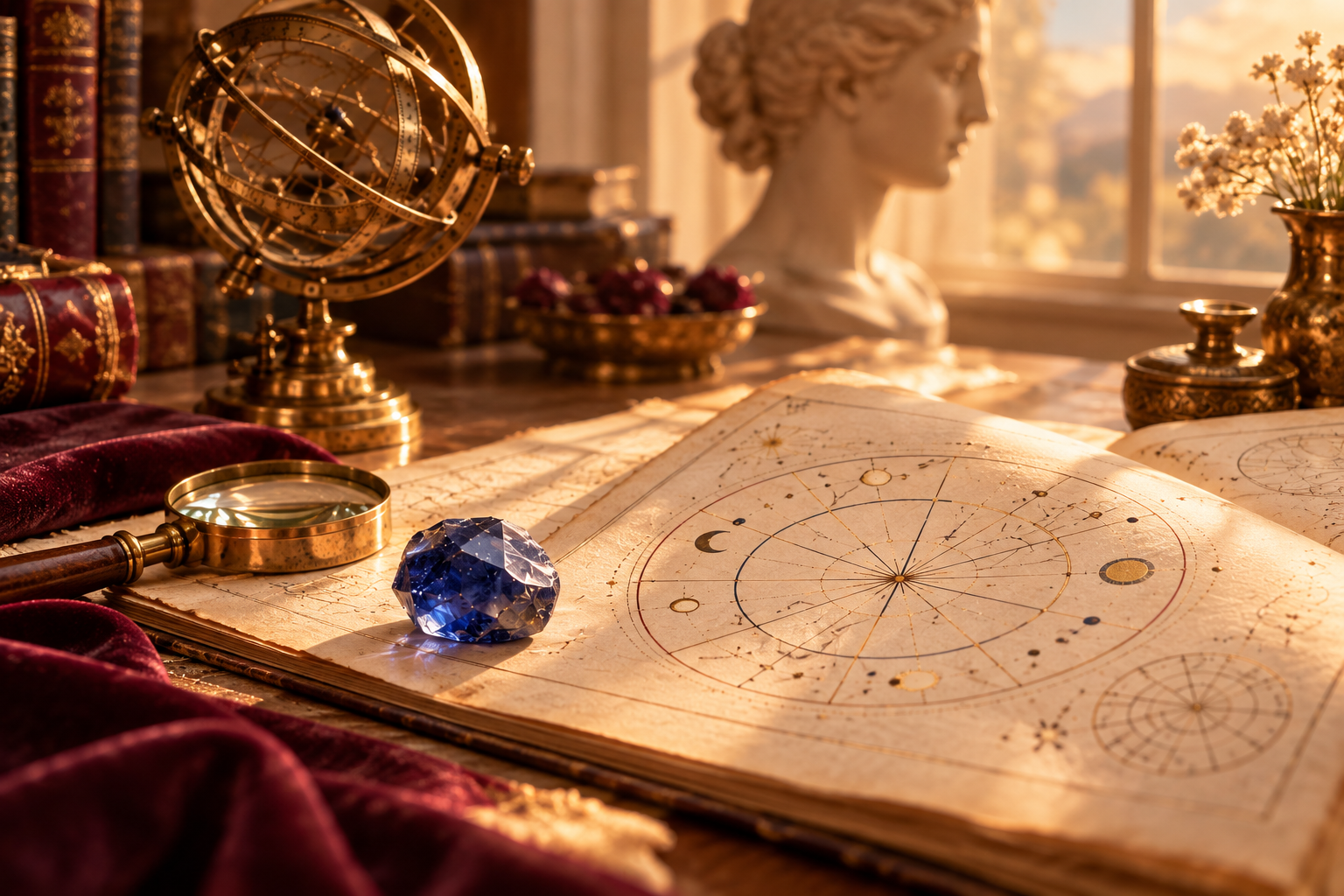
In Vedic astrology, the Lagna (pronounced LUHG-nuh — the ascendant, your rising sign, the zodiac degree on the eastern horizon at the exact moment of your birth) is typically introduced early and moved past quickly. Students learn it, note it, and then proceed directly to the more dramatic placements — the planets that feel exciting to talk about, the ones that explain the chaos, the ones that justify the suffering with some cosmic narrative.
Guruji does not let us move past the Lagna.
“The Lagna is your brain,” he teaches. “It is the single most important part of your chart. It is your brain that keeps you alive.”
I remember the first time I heard this and felt the floor shift slightly beneath me. Not because it was complicated — it isn’t. Because it was obvious, and I had been missing it.
The brain governs everything: digestion, immunity, impulse, rest, the quality of every decision you have ever made. A brain receiving clear signals, functioning without interference — this is the foundation of a life that works. A brain compromised by confusion, by wrong information, by what the tradition calls avidya (spiritual ignorance — seeing things as other than they are) — is the source of every mistake a person makes, repeatedly, in the same recognizable pattern, wondering why.
The Sanskrit word Guruji invokes here is Viveka (vih-VAY-kuh): discernment. The capacity to distinguish what is real from what merely seems real, what serves you from what only dazzles you. Viveka lives in the Lagna. And gemstones, in the Vedic tradition, are primarily a tool for strengthening it. For sharpening the brain. For restoring clarity to someone who has been making decisions in fog — and who may not have realized the fog was there.
This is why the list in your pocket is not where we begin.
What Got Lost
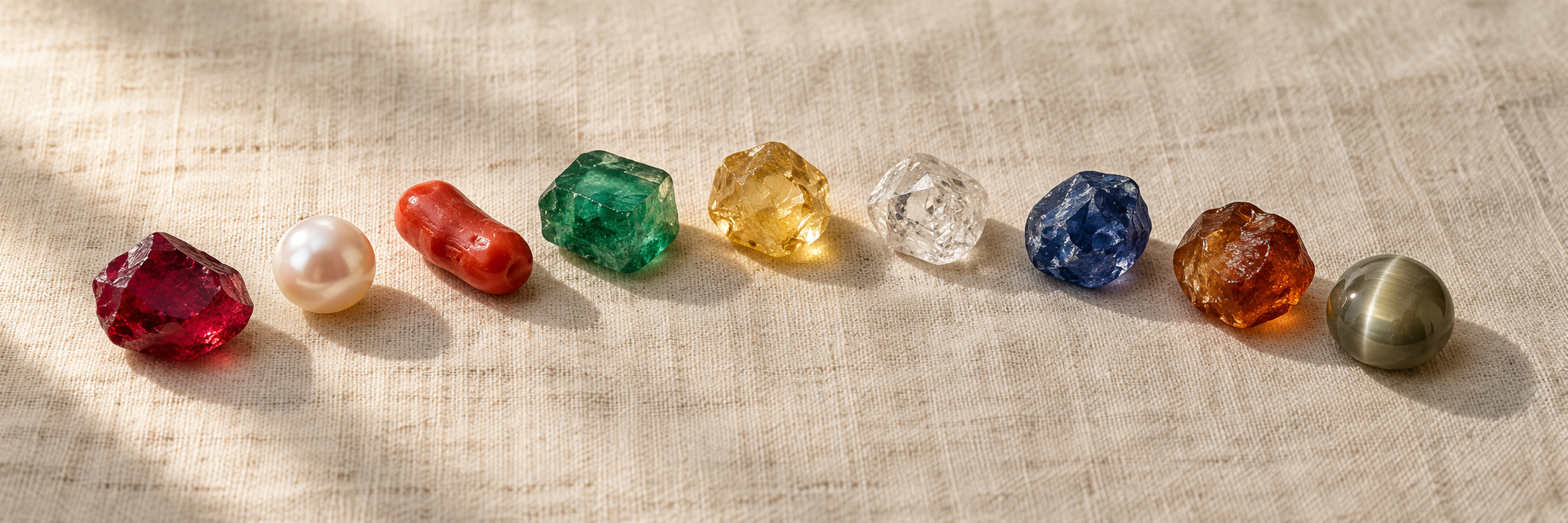
The Navaratna system — the nine planetary gemstones of Vedic astrology — is ancient, documented, and remarkably intact. What did not survive, entirely, was its organizing principle.
The original Sanskrit sources teach gemstones primarily in relation to the Lagna: the planet sitting in the ascendant, the planet ruling the ascendant, the planet ruling the ascendant of the secondary chart. This is the priority order. The Lagna is the logic.
But the versions that reached the internet — the translated, accessible, market-friendly versions — reduced the system to simpler terms. Wear your Moon stone. Wear your Sun stone. Wear the stone of your dominant planet. Easy to explain. Easy to sell. And not quite what the tradition actually teaches.
Guruji calls this a great loss. I believe him. The Rahu and Ketu gemstones — Gomedha (hessonite garnet) and Cat’s Eye (chrysoberyl) — are the most visible casualties. Because Rahu and Ketu (the north and south nodes of the Moon — points in space, not physical planets, associated with karmic patterns and intensity) do not rule signs in the traditional system, they were quietly dropped from most gemstone prescriptions. But Rahu and Ketu absolutely occupy the Lagna. They sit there, in the ascendant, doing very specific things to the brain. And when they do, the remedy is direct.
I will not drop them.
What This Means for You
You are reading this because at some point — in a shop, in someone’s hand, at an inconvenient hour of the morning staring at something blue on a screen — you felt something a stone did not entirely explain.
Hold that feeling. It is data.
A gemstone in the Vedic tradition is a remedy for the brain. Not an accessory, not a talisman in the folk sense, not something you wear because your Sun is in Leo and the stone is beautiful. It is a vibrational instrument — the tradition teaches that each planetary gemstone carries and transmits the frequency of its corresponding planet, and that when worn correctly against the skin, it begins to strengthen that planetary energy in your chart.
When worn correctly. We will get to what that means.
For now: the first question is not which stone. The first question is where you are beginning. And you are beginning with the Lagna — the ascendant, the brain, the seat of Viveka — because that is where the tradition begins.
Everything else unfolds from there. Including, eventually, the list.
Next: Meet the Nine — the Navaratna gemstones, their Sanskrit names, and what each one actually governs.
Into the Depths: A Gemstone Series (Ratna) is a nine-part series on Vedic gemstone wisdom for the seeker, the feeler, and the discerning buyer.
Yours,
Krystal / Toronto
